
Search Changed While You Were Making Worksheets
Two shifts define how teachers find resources in 2026.
First, the zero-click reality. Between 60% and 80% of Google searches now end without a click to any external website. Google answers the question on the results page, and the searcher never leaves. Fighting for a blue link matters less than it did five years ago.
Second, teachers increasingly skip the search bar entirely. They ask ChatGPT, Perplexity, or Gemini: "What's a good hands-on resource for teaching equivalent fractions to third graders?" This is Answer Engine Optimization (AEO) territory, and it rewards different signals than classic SEO.
Here is the insight that changes how you should write descriptions: optimizing for Google is no longer a fight for position #3 in the results. It is a fight to become the single verified answer that an AI engine cites when a teacher asks for a recommendation. The AI engines learn what to recommend largely from what Google indexes. Feed Google a deep, structured description, and you feed the AI engines at the same time.
TpT Internal Search: The Sprint
TpT runs its search on Algolia, and the algorithm is built for fast conversion. It wants to show a teacher the most relevant product for the exact words she typed, right now.
That makes the first 150–200 characters of your description the most valuable real estate you own. This is what appears in the TpT search results snippet, and it is often the only text a buyer reads before deciding whether to click. Waste it on "Thank you for visiting my store!" and you have wasted the click.
A snippet that earns the click names three things: the result, the grade level, and the activity type. A teacher scanning results is asking one question — "is this for my classroom, this week?" — and your first two sentences must answer it.
TpT's algorithm also watches what happens after the search results load. Click-through rate and conversion rate feed back into your ranking. A product that gets clicked and bought climbs; a product that gets scrolled past sinks. This is why the snippet matters twice: it wins the click, and the click wins the ranking.
Google and AI Search: The Marathon
Google wants what TpT's algorithm does not: depth. Its systems reward pages with clear heading hierarchy, related terms and synonyms (LSI keywords) that prove topical coverage, and structured data it can parse.
AI search engines add two requirements of their own.
Retrieval bias toward narrative. ChatGPT and Perplexity favor content that explains how and why, not just what. A bullet list saying "includes 24 task cards" tells an AI engine nothing it can recommend. A paragraph explaining how those task cards support differentiated instruction in a mixed-ability classroom gives it a reason to cite you.
Semantic chunking. AI crawlers split long pages into fragments of roughly 100–300 words and retrieve those fragments independently. A description written as one unbroken block becomes one unusable chunk. The same text split into focused, self-contained paragraphs under descriptive headings becomes five or six citable answers.
You cannot skip this work even though zero-click search sends fewer direct visitors. Google's index is the primary data source AI engines draw on. A description that Google can parse deeply is a description ChatGPT can recommend.
The Conflict: Why One Text Struggles to Serve Two Masters
Put the two sets of requirements side by side and the tension is obvious:
|
TpT internal search |
Google / AI search |
|
|---|---|---|
|
Length |
Short and direct |
Long and thorough |
|
Keywords |
Commercial phrases buyers type: fraction worksheets 3rd grade |
Synonyms and conversational questions: how to teach fractions visually |
|
Structure |
Benefit lists, quick scanning |
Heading hierarchy, paragraphs, FAQ |
So the seller's dilemma: a description long enough to feed Google looks like a wall of text to a TpT buyer, and a description tight enough for TpT gives Google nothing to index.
The way out is not compromise. It is sequencing. TpT buyers read the top of the description; Google and AI crawlers read all of it. Put each audience's content where that audience actually looks.
The Hybrid Formula: Four Blocks, Top to Bottom
Block 1: The TpT snippet and hook (first 2–3 sentences)
Job: win TpT internal search and the click.
Formula: primary keyword + grade level or purpose + main benefit.
Example: "These 3rd grade fraction worksheets give your students 40 pages of scaffolded practice with equivalent fractions, comparing fractions, and fractions on a number line — no prep required. Perfect for math centers, homework, and quick assessments."
The primary keyword appears in the first sentence, the grade level flags the right buyer, and the benefit answers "why this one?"
Block 2: The core value (what's in the box)
Job: convert the TpT buyer who clicked.
A scannable list of exactly what the file contains: page count, format, answer keys, digital versions, and the skills each component targets. Buyers at this stage are comparing you against two other open tabs. Specifics win: "40 pages, 8 exit tickets, answer keys, and a Google Slides version" beats "a comprehensive fraction resource" every time.
Block 3: The narrative and context (for Google and AI)
Job: give search engines and AI crawlers chunks worth citing.
Below the buyer-facing content, write 3–5 short paragraphs of 100–150 words each, one topic per paragraph, answering the how and why questions:
-
How does this resource fit into a fraction unit?
-
Why does the visual-model approach work for students who struggle?
-
How can you use it for differentiation — which pages for intervention, which for enrichment?
TpT buyers who are still reading at this depth are your most interested prospects, and this section sells them too. Readership research has shown this for decades: the more you tell, the more you sell — to the reader who is genuinely in the market.
Block 4: FAQ and standards (the technical block)
Job: structured data, long-tail keywords, and objection handling.
Close with 3–4 real questions in question-and-answer format ("Does this align with Common Core 3.NF?", "Can I use this with Google Classroom?") and list the standards the resource covers. Google gives structured FAQ content preferential treatment in results, each question is a conversational search query in disguise, and every answered objection is one less reason to leave without buying.
Executing the Formula with TpTSEO Tools
The formula tells you what to write. Three tools on TpTSEO tools tell you which words to use and whether they worked.
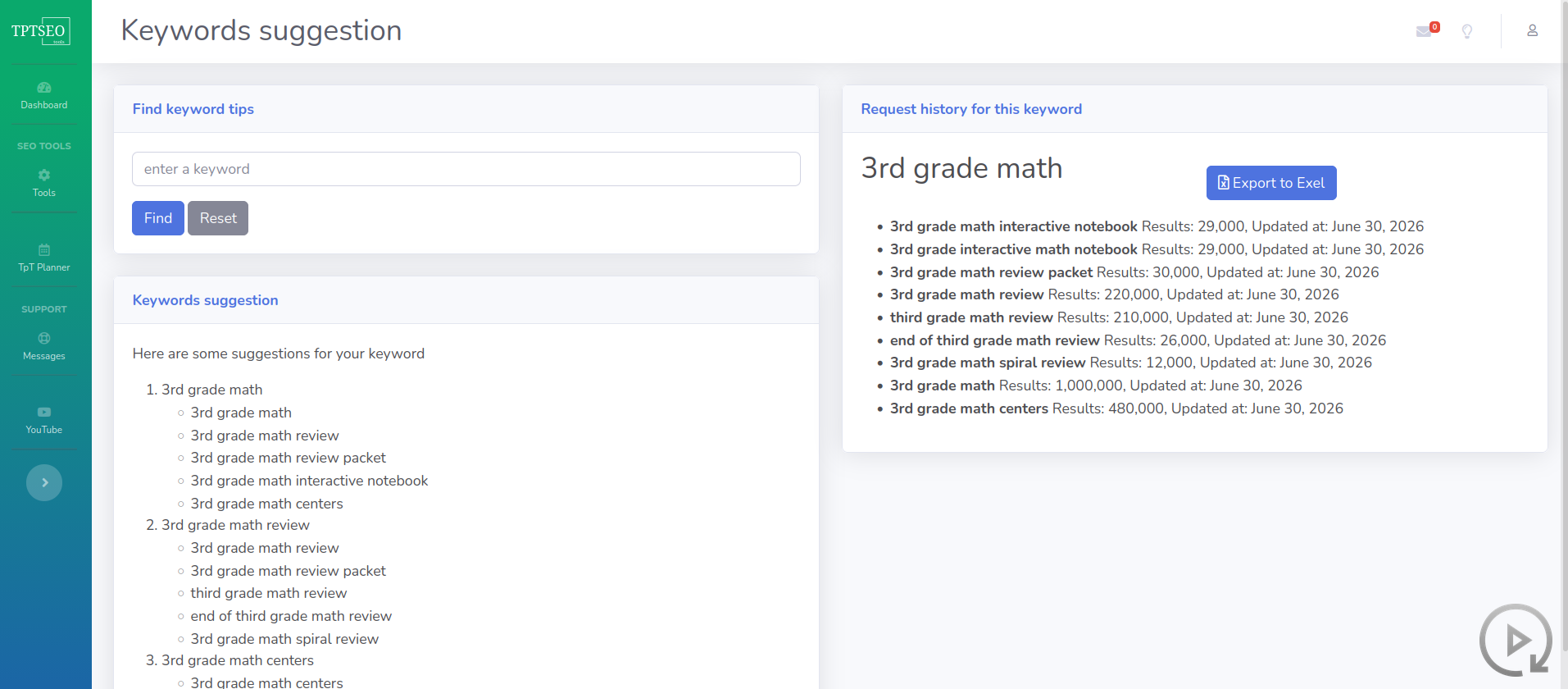
Keyword Suggestions pulls autocomplete data straight from the TpT search bar, so Block 1 is built on phrases teachers actually type, not phrases you guess at. Type your topic, pick the long-tail variation with real volume and beatable competition, and lead your snippet and title with it.
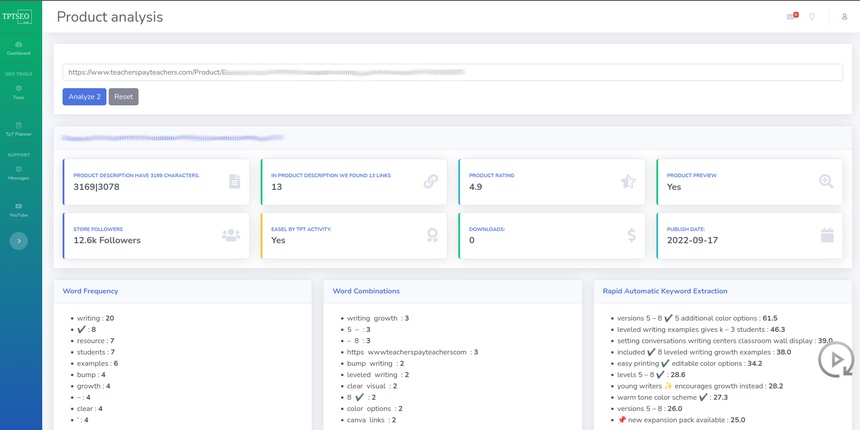
Product Analysis shows you how the top-ranking competitors for your keyword structure their descriptions: how long they run, which related terms they weave in, how they organize their sections. Use it to calibrate Block 3 — if the products outranking you all explain classroom usage in depth, that is the depth Google is rewarding in your niche.
Keyword Monitoring records your product's TpT search position every day. Rewrite a description with the hybrid formula, then watch what the ranking does over the following weeks. If it climbs, the formula is working; if it stalls, adjust the snippet or the title and measure again. Evidence beats guesswork.
Your Description Audit Checklist
The era of stuffing descriptions with tag lists is over. The sellers winning now build deep, structured content that TpT's algorithm, Google's crawler, and AI engines can all digest. Run every product page through this checklist:
 Do the first two sentences contain your primary TpT search phrase, the grade level, and the main benefit?
- Is the description broken into self-contained chunks of 100–200 words, each on one topic?
- Does the text answer "how do I use this?" and "why does it work?" — the questions AI engines retrieve?
- Did you build the snippet and title on real search data from Keyword Suggestions, not guesses?
- Is there an FAQ block with genuine buyer questions and standards alignment?
Sign up for free at TpTSEO tools to find the keywords for Block 1 and track whether your hybrid descriptions climb the rankings.