
The Core Difference Between Search Analytics and Planning Tools
The built-in TpT Search Analytics dashboard works well for post-launch evaluation. It tells you which search terms brought buyers to your existing products over the last thirty days. That data helps you tweak active listings. It offers nothing when you sit down to decide what product to create next.
Planning requires forward-looking data. Before you spend weeks on a curriculum bundle, you need to know what teachers search for and whether the niche is too crowded. The native dashboard reports your own store's performance; it cannot show you market-wide opportunities. External TpT SEO tools fill that gap.
How the Teachers Pay Teachers Search Engine Works
Teachers Pay Teachers runs its search on Algolia, and the ranking formula rests on two pillars.
Textual relevance measures how closely your product title, description, and meta-tags match the words a teacher types into the search bar. Business metrics cover your conversion rate, total downloads, sales history, and product ratings.
Algolia weighs both on each query, and new sellers lose that trade. A resource with flawless textual optimization still sits below older products with thousands of reviews, because those products win on business metrics. To rank, target search terms where the giants have no foothold.
Step 1: Finding Long-Tail Keywords to Beat the Giants
You will not beat established TpT veterans on generic, high-volume terms. Target "math" or "music" and your product gets buried under pages of five-star resources with tens of thousands of downloads. Long-tail keywords give you a way in: longer, specific phrases buyers type when they need a precise solution.
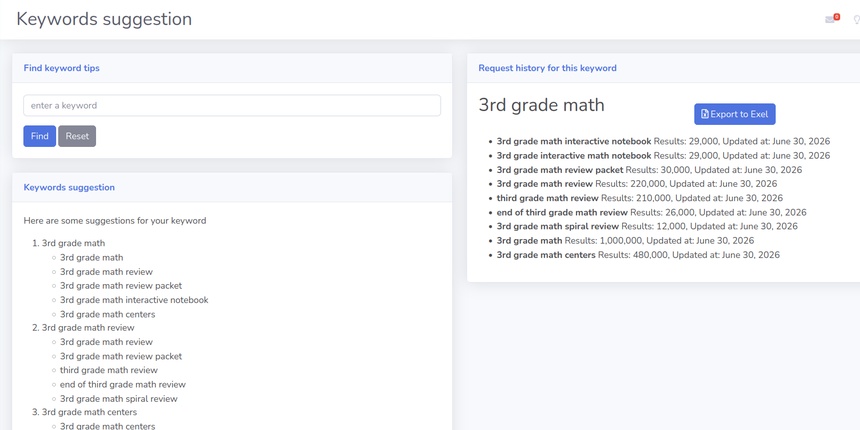
The Keyword Suggestions tool on TpTSEO tools captures autocomplete data from the TpT search bar, so you see what teachers type instead of guessing. If you plan a math resource, type "3rd grade math" rather than "math". The tool extracts the search paths the platform suggests:
-
3rd grade math interactive notebook
-
3rd grade math review packet
-
3rd grade math centers
-
3rd grade math spiral review
Each variation comes with an estimated monthly search volume. Pick a targeted phrase the established giants ignore, and your new product gets a fair shot at ranking.
Step 2: Analyzing the Competition with Keyword SERP Analysis
Before you spend hours creating a resource for a phrase like "3rd grade math spiral review", check whether you can break into the top 20 results.
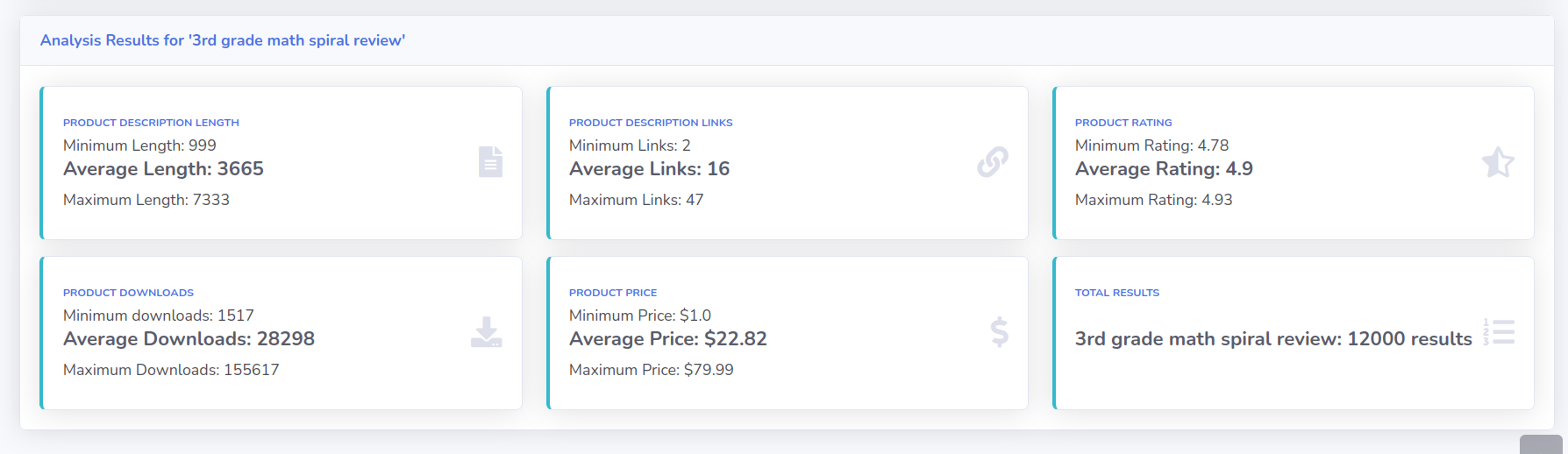
The Keyword SERP Analysis tool on TpTSEO tools scans the top 20 products ranking for your keyword and reports their metrics:
-
Product description length: minimum 999 characters, average 3,665, maximum 7,333
-
Product description links: minimum 2, average 16, maximum 47
-
Product rating: minimum 4.78, average 4.9, maximum 4.93
-
Product downloads: minimum 1,517, average 28,298, maximum 155,617
-
Product price: minimum $1.00, average $22.82, maximum $79.99
-
Total results: 12,000
Read the description stats first. If top-ranking products average 3,600 characters and 16 internal links, write a description that matches that depth and link to your other relevant resources to build topical authority.
Then read the pricing. At an average price of $22.82, buyers searching this term expect complete bundles, and a $2.00 worksheet will struggle. If buyers download expensive products in large numbers, they pay for full curriculum packages. Set your product's scope from these numbers before you write a single page.
Step 3: Tracking Your Success with Daily Rank Monitoring
Publishing an optimized product starts the next phase: finding out whether your SEO strategy worked. You need to know if you are climbing the ranks or stuck on page five.
Searching for your own product by hand each day is tedious, and personalized results make it inaccurate. The Keyword Monitoring tool on TpTSEO tools records your product's position in the search results each day.
If your product reaches the top 20 within weeks, your keyword choice and optimization worked; shift to driving external traffic to raise your conversion rate and hold the position. If your rank stalls outside the top 50, adjust: rework the title, add relevant terms to the description, or redesign the cover to lift click-through rates. With daily monitoring, you adjust from evidence instead of guesswork.
Sign up for free at TpTSEO tools to find low-competition keywords and track your ranks.